
Building materials & housing equipment × digital entry · August 2026
Japan Building Materials: How Foreign Suppliers Get Shortlisted When Housing Starts Move Without Volume
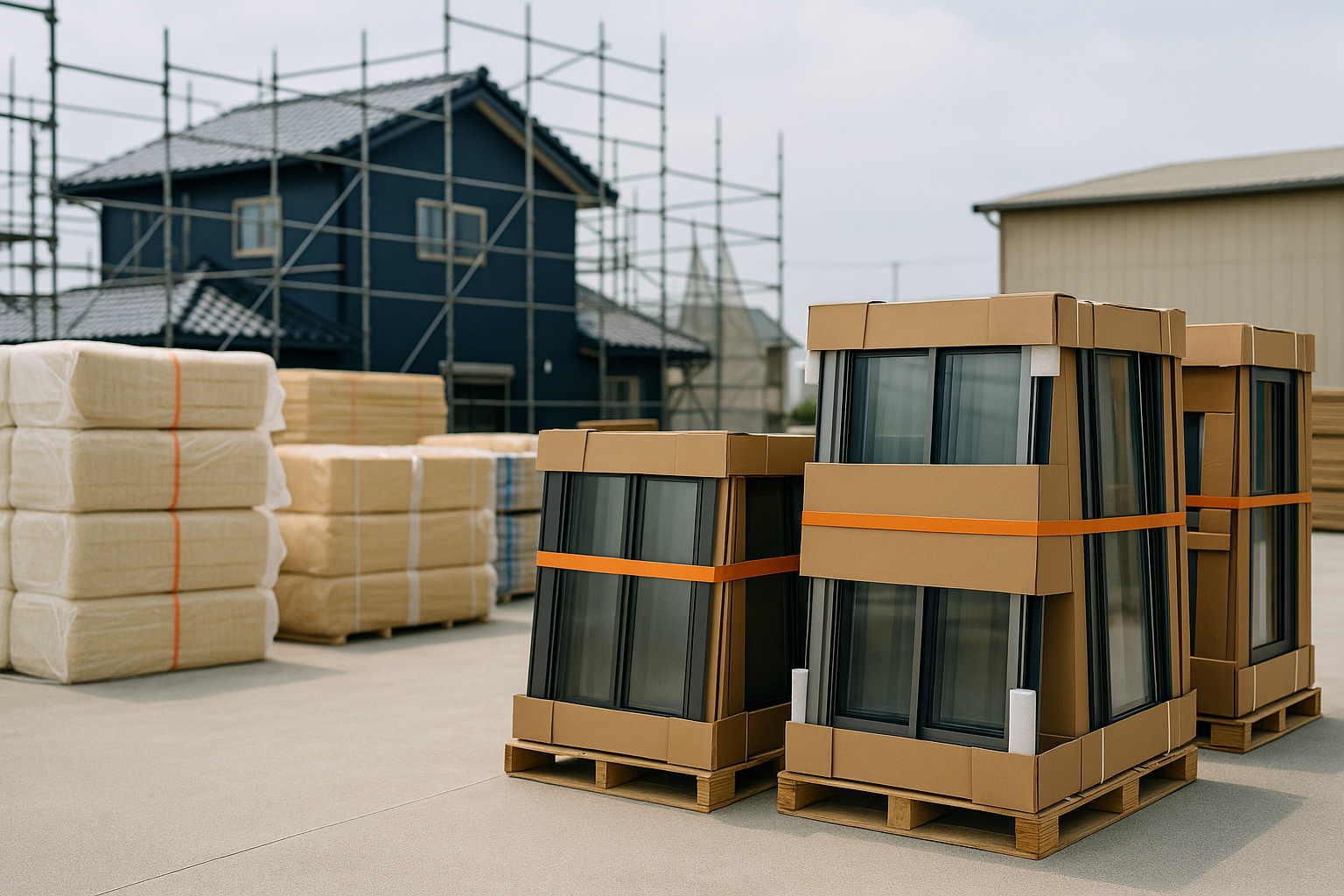
In Japan’s housing materials market, more housing starts do not automatically mean more share for a foreign brand — and a flat materials market does not mean nothing is moving. Yano Research Institute estimates the major six housing building-materials fields at 1.551 trillion yen in FY2024 (manufacturer shipment basis), essentially flat at 99.9% of the prior year. Separately, Japan’s Ministry of Land, Infrastructure, Transport and Tourism (MLIT) reports FY2024 new housing starts at roughly 816 thousand units, up about 2.0% year-on-year — the first annual increase in three years. The gap between those two clocks is the story foreign suppliers need. Volume headlines can rise on pull-forward construction; specification, energy-performance, and Japanese-language evaluation surfaces decide who stays on the shortlist. This article is written for overseas decision-makers. It is not a guide for Japanese firms going abroad.
The bottom line — read starts, shipments, and regulation as three clocks
Housing starts rose in FY2024. Materials shipments in the six Yano fields barely moved. High-performance categories — insulation, resin sash, multi-layer glass — held up better than the aggregate. From April 2025, amendments to Japan’s Building Standards Act and Building Energy Efficiency Act tightened the compliance path for many buildings. Foreign entrants who treat Japan as a volume recovery trade will mis-hire distributors. Foreign entrants who treat Japan as a specification and proof market will build the right Japanese assets first.
What the market numbers actually say
Yano’s FY2024 estimate of 1.551 trillion yen covers six residential-oriented fields: wood-based finish products, ceramic, metal, plastic, insulation, and interior. It deliberately excludes structural timber, housing equipment, and planting. That exclusion matters. “Building materials” in a board deck is often wider than Yano’s six fields — and housing equipment (kitchens, baths, HVAC-related fixtures) sits in a sibling category that industry associations track separately. The Japan Building Materials & Housing Equipment Industries Association (Kensankyo) publishes an annual statistical yearbook that compiles government production and housing-start series across eight domains, including 51 housing-equipment items. Use the right denominator before you size a Japan P&L.
Yano forecasts FY2025 at 1.549 trillion yen (again about 99.9% of the prior year) and 2030 at 1.522 trillion yen (about 98.1% of FY2024). The directional story is not explosive growth. It is gradual pressure from demographics, with pockets of resilience where performance and price pass-through hold.
Why starts rose while materials stayed flat
MLIT’s housing-start series shows FY2024 (April 2024–March 2025) at about 816 thousand new dwellings, up roughly 2.0% from FY2023. Trade and ministry commentary attributes much of the late-FY2024 acceleration — especially March 2025 — to pull-forward ahead of April 2025 regulatory changes: revisions tied to the Building Standards Act and the Building Energy Efficiency Act, including energy-performance conformity obligations for a wider set of buildings and changes to simplified confirmation pathways that had applied to certain small wooden buildings.
Pull-forward creates starts without a proportional, sustained materials boom. Builders accelerate applications and starts; materials demand spikes unevenly by SKU and then normalizes. MLIT’s April 2025 monthly report shows new housing starts down 26.6% year-on-year as the pull-forward unwound. A foreign supplier reading only the FY2024 annual uptick will overestimate steady-state demand.
Where the money still concentrates — performance, not novelty
Yano notes that price revisions, higher value-add, and materials that support high-performance housing — insulation, resin sash, multi-layer glass — remained relatively firm even while the six-field total was flat. Decarbonization and environmental product disclosure (for example SBT and EPD activity in industry discourse) are rising as buyer and manufacturer themes. For a foreign entrant, that means the commercial argument is less “new brand from overseas” and more “documented thermal, acoustic, fire, and installation performance that a Japanese specifier can put in a confirmation package.”
How Japanese shortlists actually form
Housing materials and equipment buying in Japan is specification-led and channel-reinforced. House builders, remodelers, general contractors, and trading houses evaluate grades, certifications, installation manuals, after-sales paths, and domestic references. The first digital pass is rarely a lifestyle film. It is a Japanese dossier: searchable product names, dimensional and performance tables, compatible construction methods, and a locatable Japan-side contact. English-only microsites that open with Western benefit claims usually fail that pass even when the translation is accurate.
Distributors remain rational for regulated SKUs, small initial volumes, or accounts that already buy through a house. They are the wrong first move when your hypothesis is “Japan will buy once they understand us.” In that case the distributor owns the conversation, and your brand never gets stress-tested. Sequence a Japanese evaluation surface first, then decide where a house account still earns its margin.
A misconception market-entry teams often hold
“Housing starts are up, so Japan is opening” confuses a regulatory pull-forward with a structural demand boom. Another misconception: treating housing equipment and finish materials as one TAM. Yano’s six fields exclude housing equipment; Kensankyo’s yearbook keeps equipment as its own large block. Size the category you actually sell. A third misconception: assuming global ESG badges replace Japanese installation and confirmation detail. Badges help. Spec sheets and Japan-side accountability close.
So what for a foreign entrant — three decisions
1. Separate starts from shipments from compliance. Model FY2024’s start uptick as partly temporary. Anchor materials sizing to the correct field definition — and do not paste a “housing equipment” number onto a finish-materials plan.
2. Compete on performance documentation, not slogan volume. Insulation, sash, glass, and related high-performance lines are where resilience showed. Build Japanese-language evidence that a specifier can reuse in confirmation and energy-performance workflows.
3. Ship a native Japanese evaluation page before you scale distributor coverage or trade-show spend. Specs, installation, certifications, returns/support hours, and Japan-relevant proof beat a translated brand film. Measure whether Japanese search and AI answers can describe your offer accurately.
Branching paths through 2027–2030
One path: demographic pressure keeps the six-field total gently declining while performance niches and renovation hold share — winners are the suppliers whose Japanese digital dossier is confirmation-ready. Another path: energy-performance obligations and disclosure norms raise the documentation bar further — winners invest in bounded, attributed claims and Japan-side support rather than in louder English advertising. In both paths, foreign brands that wait for “Japan volume to return” will discover that shortlists already formed without them.
Japan’s building-materials opportunity for foreign suppliers is real, selective, and documentation-heavy. Starts can rise while shipments stay flat. Regulation can move calendars without rewriting demographics. The practical work is to put specification-grade Japanese assets where builders, remodelers, and machines can find them — then decide, with data, where distribution still adds value. Regulatory references here are orientation, not legal or engineering advice. Building confirmation, energy-performance conformity, and product safety rules vary by product and building type; confirm with qualified advisors before launch.
FAQ
Q. Is Japan’s housing market growing again?
A. FY2024 housing starts rose about 2.0% on an MLIT annual basis, partly on pull-forward before April 2025 rule changes. The six-field materials market Yano tracks was essentially flat. Read both series.
Q. Does “building materials” include kitchens and baths?
A. Not in Yano’s six-field definition. Housing equipment is tracked separately by industry sources such as Kensankyo’s yearbook. Size the category you sell.
Q. Do we need a Japanese site if we sell through a trading company?
A. If the trading company owns every specifier conversation, audit their materials. If you want brand pull or direct technical inquiries, you need your own Japanese evaluation surface.
Q. What should we publish first in Japanese?
A. Performance and installation detail a confirmation package can use: dimensions, grades, compatible methods, certifications, and Japan-side support — written natively, not translated from a Western benefit page.
UDX builds native Japanese digital assets for foreign industrial and housing-related brands entering Japan — written natively rather than translated.
Japan Market-Fit Report →Primary sources
Yano Research Institute, PR No.3964 (November 19, 2025), housing building-materials market survey — FY2024 1.551 trillion yen; FY2025/2030 outlook; six-field definition. Yano PR. MLIT, Building Starts Survey — FY2024 (Reiwa 6) new housing starts ≈816 thousand (+≈2.0%); April 2025 monthly report (−26.6% YoY). MLIT April 2025 press / correction and annual tables in MLIT/e-Stat releases. Japan Building Materials & Housing Equipment Industries Association (Kensankyo), Statistical Yearbook page — eight domains / 240 items including housing equipment. Kensankyo. April 2025 Building Standards Act / Building Energy Efficiency Act changes: orientation only — confirm current MLIT guidance for your product class.